On this page
- Introduction
- Understanding All-on-6: A Brief Overview
- Why All-on-6 Treatment Requires Multiple Visits
- The Typical All-on-6 Timeline: What to Expect
- Factors That Affect All-on-6 Healing Time and Scheduling
- Bone Density and Quality
- Smoking Status
- Diabetes and Systemic Health Conditions
- Number and Complexity of Extractions
- Bone Grafting Requirements
- Immediate vs. Delayed Loading Protocol
- Your Compliance with Aftercare Instructions
- Bite Forces and Parafunctional Habits
- Dentist's Treatment Philosophy and Protocols
- Laboratory Quality and Turnaround Time
- Practical Planning Advice for International All-on-6 Patients
- Conclusion: Key Takeaways for International All-on-6 Patients
If you're considering traveling abroad for All-on-6 dental implant treatment, you've probably asked yourself: "How many visits will I actually need?" It's one of the most common questions international patients have, and for good reason. Understanding the timeline for your All-on-6 procedure is crucial for planning your travel, budgeting your expenses, and setting realistic expectations for your full-mouth restoration journey.
The truth is, All-on-6 treatment isn't a one-and-done affair. While modern dentistry has made tremendous advances in efficiency and technology, this comprehensive full-arch restoration still requires multiple visits to ensure optimal results, proper healing, and long-lasting outcomes. This isn't about dentists trying to extend your treatment—it's about biology, precision, and giving your body the time it needs to integrate six dental implants that will support your entire new set of teeth for decades to come.
In this comprehensive guide, we'll walk you through everything you need to know about All-on-6 treatment visits: why multiple appointments are necessary, what the typical timeline looks like, what factors affect your healing time, and most importantly, how to plan your international dental journey strategically. Whether you're replacing all your upper teeth, lower teeth, or both arches, this article will help you understand what to expect and how to prepare for this life-changing procedure.
Compare All-on-4 and All-on-6 options
Get a second opinion and see which full-arch option fits your anatomy, timeline, and budget.
Understanding All-on-6: A Brief Overview
Before we discuss the visit schedule, let's clarify what All-on-6 treatment involves. This is a full-arch dental restoration technique where six strategically placed dental implants support a complete set of prosthetic teeth (10-14 teeth per arch). The implants are surgically placed into your jawbone, where they fuse with the bone over several months through a process called osseointegration. Once fully integrated, these implants serve as permanent anchors for your new teeth.
All-on-6 offers several advantages over traditional dentures: superior stability, no slipping or clicking, preservation of jawbone, improved chewing function, and a more natural appearance. However, achieving these benefits requires a carefully staged treatment process that respects your body's biological healing timeline.
Why All-on-6 Treatment Requires Multiple Visits
Understanding why you can't complete All-on-6 in a single trip is essential for planning your international dental journey. These aren't arbitrary requirements—they're based on sound medical and biological principles that directly impact your treatment success.
Osseointegration: The Non-Negotiable Healing Period
The most critical factor determining your All-on-6 timeline is osseointegration—the process by which your jawbone grows around and fuses with the titanium implants. This biological process typically takes 3-6 months, though it can extend to 12 months in some cases. There is simply no way to speed up this process without compromising the long-term success of your implants.
During osseointegration, your bone cells gradually attach to the implant surface, creating a bond stronger than the original tooth root. This fusion is what gives All-on-6 its remarkable stability and longevity. Attempting to place permanent prosthetics before osseointegration is complete risks implant failure, as the implants haven't yet achieved the stability needed to withstand normal chewing forces.
While some clinics offer "same-day teeth" or immediate loading protocols where temporary prosthetics are placed on the day of surgery, these are still temporary solutions. The permanent, final prosthetic—the one designed to last 10-15+ years—can only be placed after complete osseointegration.
Temporary vs. Permanent Prosthetics: Two Distinct Phases
All-on-6 treatment involves two different prosthetic phases, each serving specific purposes:
Temporary Prosthetics: These are lighter, less expensive prosthetics placed either immediately after surgery or within a few weeks. They're designed to be functional and aesthetic during the healing period, allowing you to eat soft foods and smile confidently while your implants integrate. However, they're not built to withstand the full force of normal chewing and aren't as precisely fitted or aesthetically refined as the final prosthetic.
Permanent Prosthetics: These are the final, definitive restorations—typically made from high-quality materials like zirconia or porcelain fused to metal frameworks. They're custom-crafted to exact specifications after your implants have fully integrated, ensuring perfect fit, optimal bite alignment, and superior aesthetics. The fabrication of permanent prosthetics alone takes 2-4 weeks in a quality laboratory.
This two-phase approach means you'll need at least two separate visits: one for implant placement (and possibly temporary prosthetic placement), and another for final prosthetic delivery after healing is complete.
Bite Adjustment and Aesthetic Refinement
Getting your bite exactly right is crucial for All-on-6 success. An improper bite can cause implant failure, jaw pain, excessive wear, and other complications. During the temporary prosthetic phase, your dentist monitors how your bite settles, how your jaw muscles adapt, and how the prosthetic functions during daily use.
This trial period provides invaluable information that guides the design of your permanent prosthetic. Your dentist can identify pressure points, adjust the vertical dimension (how "tall" your bite is), refine tooth positioning, and make aesthetic modifications based on your feedback. This iterative process requires multiple appointments and simply cannot be rushed.
Monitoring for Complications
All-on-6 is a major surgical procedure, and like all surgeries, it carries risks of complications. Regular monitoring during the healing period allows your dentist to identify and address issues early:
- Implant stability: Checking that implants are integrating properly and not showing signs of mobility
- Infection: Detecting and treating any post-surgical infections before they compromise implants
- Bone loss: Monitoring for any unexpected bone resorption around implants
- Soft tissue healing: Ensuring gums are healing properly around implant sites
- Prosthetic fit: Verifying that temporary prosthetics aren't causing pressure points or tissue irritation
International patients face unique challenges with complication monitoring, which is why strategic visit scheduling and clear communication protocols with your dental team are essential.
Extraction Healing When Needed
Many All-on-6 patients require extraction of remaining teeth before implant placement. If you have teeth that need removal, your treatment timeline extends further. Extraction sites need 3-4 months to heal before implants can be placed, though some protocols allow for immediate implant placement into fresh extraction sockets if bone quality permits.
The decision between immediate implant placement and delayed placement depends on factors like infection presence, bone quality, and the number of extractions needed. Your dentist will determine the best approach for your specific situation, but extraction healing adds another phase to your treatment timeline.
Bone Grafting Requirements
Patients with significant bone loss—common among those who've had missing teeth for years or worn dentures long-term—often require bone grafting before or during implant placement. Bone grafts need 4-6 months to mature before implants can be placed or before the implants can be loaded with prosthetics.
Some All-on-6 cases can proceed with simultaneous bone grafting and implant placement, while others require staged procedures: bone grafting first, healing period, then implant placement, another healing period, then prosthetic placement. Your specific bone condition significantly impacts your treatment timeline.
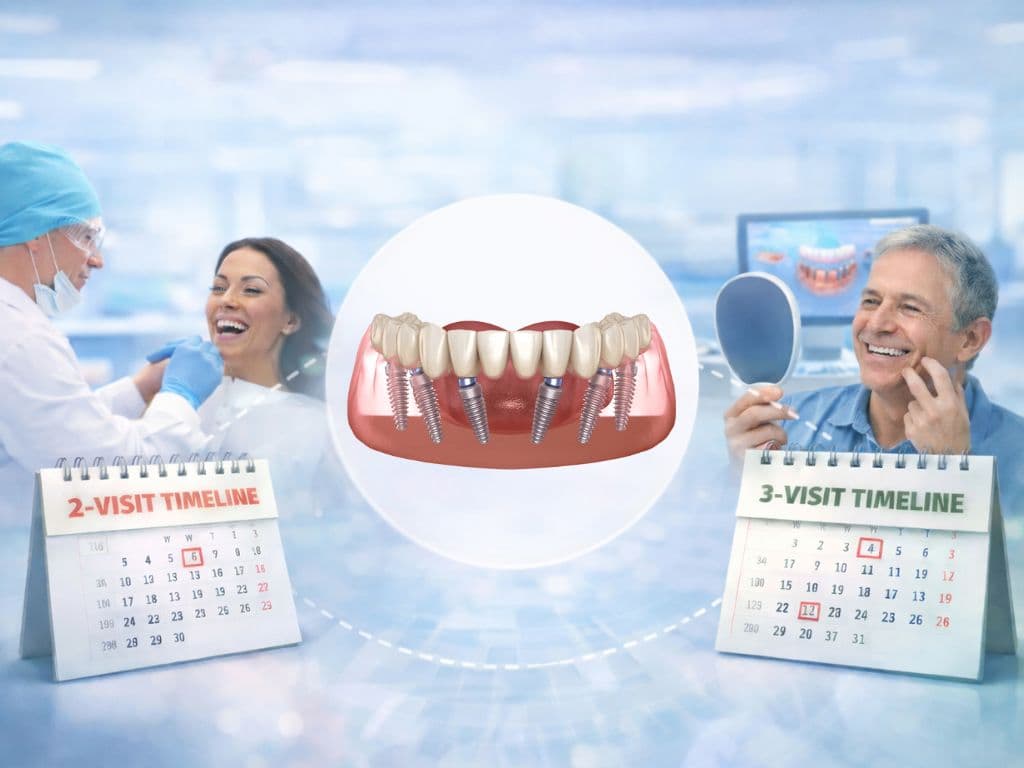
The Typical All-on-6 Timeline: What to Expect
While every patient's journey is unique, most All-on-6 cases follow a general timeline. Understanding this helps you plan your international travel and set realistic expectations.
Standard Timeline (No Extractions or Grafting Needed)
Visit 1: Consultation, Planning, and Implant Placement (5-7 days)
Your first trip typically lasts about a week and includes:
- Day 1-2: Comprehensive examination, 3D CT scans, treatment planning, medical clearance
- Day 3: Implant placement surgery (2-4 hours per arch)
- Day 4-5: Post-operative check-up, suture check, temporary prosthetic placement (if immediate loading protocol is used)
- Day 6-7: Final check before departure, instructions for healing period
Some clinics place temporary prosthetics on the same day as surgery (immediate loading), while others wait 2-4 weeks for initial healing before placing temporaries. If delayed loading is used, you may need to return for a second short visit to receive your temporary prosthetic, or arrangements may be made with a local dentist in your home country.
Healing Period: 3-6 Months at Home
During this period, osseointegration occurs. You'll wear your temporary prosthetic (if placed), follow a modified diet, maintain meticulous oral hygiene, and have regular check-ins with your dental team (often via video calls or with a local monitoring dentist).
Visit 2: Final Prosthetic Delivery (7-10 days)
Your second trip, occurring 3-6 months after implant placement, includes:
- Day 1: Examination, X-rays to confirm osseointegration, removal of temporary prosthetic
- Day 2-3: Final impressions, bite registration, shade selection, try-in of prosthetic framework
- Day 4-7: Laboratory fabrication of permanent prosthetic
- Day 8: Delivery and fitting of permanent prosthetic, bite adjustments
- Day 9-10: Follow-up appointment for final adjustments, instructions for long-term care
Total Timeline: 4-7 months from start to finish, requiring two international trips totaling 12-17 days abroad.
Extended Timeline (With Extractions)
Visit 1: Extractions and Healing (3-5 days)
- Comprehensive examination and planning
- Extraction of remaining teeth
- Possible socket preservation grafting
- Temporary denture placement for aesthetics during healing
Healing Period: 3-4 Months
Extraction sites heal and bone remodels.
Visit 2: Implant Placement (5-7 days)
- Re-evaluation with new CT scans
- Implant placement surgery
- Temporary prosthetic placement (immediate or delayed)
Healing Period: 3-6 Months
Osseointegration occurs.
Visit 3: Final Prosthetic Delivery (7-10 days)
- Final impressions and prosthetic fabrication
- Permanent prosthetic delivery and adjustments
Total Timeline: 7-11 months, requiring three international trips totaling 15-22 days abroad.
Extended Timeline (With Bone Grafting)
Visit 1: Bone Grafting (3-5 days)
- Comprehensive examination and planning
- Bone grafting surgery (with or without extractions)
- Post-operative monitoring
Healing Period: 4-6 Months
Bone graft matures and integrates.
Visit 2: Implant Placement (5-7 days)
- Re-evaluation with CT scans to assess bone quality
- Implant placement surgery
- Temporary prosthetic placement (if immediate loading is possible)
Healing Period: 3-6 Months
Osseointegration occurs.
Visit 3: Final Prosthetic Delivery (7-10 days)
- Final impressions and prosthetic fabrication
- Permanent prosthetic delivery and adjustments
Total Timeline: 10-17 months, requiring three international trips totaling 15-22 days abroad.
Accelerated Protocols: Understanding the Limitations
Some dental clinics advertise "All-on-6 in one week" or similar accelerated timelines. While it's technically possible to place implants and temporary prosthetics in a single visit, it's crucial to understand what this actually means:
What You CAN Get in One Visit:
- Implant placement surgery
- Immediate temporary prosthetic (if bone quality and implant stability permit)
- Initial healing and adjustment period
What You CANNOT Get in One Visit:
- Permanent, final prosthetic (requires osseointegration first)
- Guaranteed long-term success without proper healing time
- Optimal bite refinement and aesthetic adjustments
Beware of clinics promising complete All-on-6 treatment in unrealistically short timeframes. While immediate loading with temporary prosthetics is a legitimate protocol, the permanent prosthetic still requires months of healing. Clinics that place "permanent" prosthetics before adequate osseointegration are taking significant risks with your treatment outcome.
Factors That Affect All-on-6 Healing Time and Scheduling
Understanding what influences your specific All-on-6 timeline helps you plan more effectively and set realistic expectations. Here are the key factors that determine how long your treatment will take:
Bone Density and Quality
Your jawbone quality is the single most important factor affecting your All-on-6 timeline. Patients with dense, healthy bone (Type 1 or Type 2 bone) typically experience faster osseointegration—sometimes as quickly as 3 months. Those with softer, less dense bone (Type 3 or Type 4) may require 6 months or longer for adequate integration.
Bone quality also determines whether immediate loading (placing temporary prosthetics on the day of surgery) is possible. Immediate loading requires excellent bone density and high initial implant stability. If your bone quality is compromised, your dentist may recommend delayed loading, where implants are left to heal for several weeks before any prosthetic is attached.
Your pre-treatment CT scan reveals your bone density, allowing your dentist to predict your likely healing timeline. This is why sending imaging in advance is so important for international patients—it allows accurate treatment planning before you travel.
Smoking Status
Smoking is one of the most significant risk factors for All-on-6 failure. Nicotine constricts blood vessels, reducing blood flow to healing tissues and dramatically slowing osseointegration. Smokers experience implant failure rates 2-3 times higher than non-smokers.
If you smoke, your dentist will likely recommend:
- Quitting entirely before treatment (ideally 2-4 weeks before surgery)
- Remaining smoke-free throughout the healing period (minimum 3-6 months)
- Extended healing periods before loading implants with prosthetics
- More frequent monitoring appointments
Some dentists refuse to perform All-on-6 on active smokers due to the high failure risk. If you cannot quit smoking, be honest with your dentist so they can adjust your treatment plan accordingly—or consider whether All-on-6 is the right choice for you.
Diabetes and Systemic Health Conditions
Diabetes, particularly poorly controlled diabetes, significantly impacts healing and osseointegration. High blood sugar levels impair immune function, slow wound healing, and increase infection risk. Diabetic patients often require:
- Extended healing periods (6-12 months for osseointegration)
- More frequent monitoring for complications
- Strict blood sugar control before and after surgery
- Possible antibiotic prophylaxis
Other systemic conditions affecting healing include:
- Autoimmune disorders: May slow healing and increase complication risk
- Osteoporosis: Can compromise bone quality and implant stability
- Heart disease: May require special precautions during surgery
- Immunosuppression: Increases infection risk and slows healing
Be completely transparent about your medical history with your dental team. International patients with complex medical conditions should consider whether the challenges of coordinating care across borders outweigh the cost savings of treatment abroad.
Number and Complexity of Extractions
The more teeth requiring extraction, the more complex your healing process. Extracting a full arch of teeth creates significant trauma that requires adequate healing time. Factors affecting extraction healing include:
- Infection presence: Infected teeth require longer healing before implant placement
- Bone loss around teeth: May necessitate socket preservation grafting
- Tooth position: Molars with multiple roots are more traumatic to extract than front teeth
- Surgical complexity: Impacted or broken teeth requiring surgical extraction need longer healing
Simple extractions in healthy bone may heal adequately in 3 months, while complex extractions with infection may require 4-6 months before implant placement is advisable.
Bone Grafting Requirements
If bone grafting is necessary, your timeline extends significantly. Types of grafting that may be needed include:
- Socket preservation grafting: Placed at time of extraction to maintain bone volume (adds 3-4 months)
- Sinus lift: Required for upper jaw implants when sinus cavity is too close (adds 4-6 months)
- Ridge augmentation: Builds up deficient bone width or height (adds 4-6 months)
- Block grafts: For severe bone loss, using bone from another site (adds 6-9 months)
Some grafting can be done simultaneously with implant placement, while severe bone loss requires staged procedures. Your pre-treatment CT scan reveals whether grafting will be necessary, allowing accurate timeline planning.
Immediate vs. Delayed Loading Protocol
Your dentist will choose between immediate loading (placing temporary prosthetic on day of surgery) or delayed loading (waiting weeks to months before placing prosthetic) based on:
- Initial implant stability: Measured during surgery; high stability (>35 Ncm torque) permits immediate loading
- Bone quality: Dense bone supports immediate loading; soft bone requires delayed loading
- Number of implants: Six implants provide more stability than four, making immediate loading more feasible
- Patient factors: Bite force, grinding habits, and compliance affect loading protocol choice
Immediate loading offers the advantage of leaving the clinic with teeth, but it doesn't accelerate the overall timeline—you still need months of healing before the permanent prosthetic. Delayed loading may actually result in higher long-term success rates in certain cases.
Your Compliance with Aftercare Instructions
How well you follow post-operative instructions dramatically impacts your healing timeline and treatment success. Critical compliance factors include:
Dietary Restrictions: During the healing period, you must follow a modified diet:
- First 2-4 weeks: Soft foods only (soups, smoothies, mashed foods)
- Months 2-3: Gradually introduce semi-solid foods
- Avoid hard, crunchy, or chewy foods until permanent prosthetic is placed
- No chewing on temporary prosthetic beyond its designed capacity
Oral Hygiene: Meticulous cleaning is essential:
- Gentle brushing around implant sites
- Prescribed mouth rinses to prevent infection
- Regular cleaning of temporary prosthetic
- Professional cleanings as recommended
Activity Restrictions: Physical activity affects healing:
- No strenuous exercise for 2-4 weeks post-surgery
- Avoid activities that could result in facial trauma
- No smoking or alcohol during healing period
- Adequate sleep and stress management
Medication Compliance: Taking prescribed medications as directed:
- Antibiotics to prevent infection
- Pain medications as needed
- Anti-inflammatory medications to reduce swelling
Patients who don't follow aftercare instructions experience higher complication rates, delayed healing, and sometimes implant failure—requiring additional visits and extended timelines to address problems.
Bite Forces and Parafunctional Habits
If you're a heavy grinder (bruxism) or clencher, your All-on-6 timeline may be affected. Excessive bite forces during the healing period can prevent proper osseointegration or cause implant failure. Your dentist may recommend:
- Delayed loading protocol (no prosthetic for first 2-3 months)
- Night guard to protect implants during sleep
- Extended healing period before placing permanent prosthetic
- Reinforced prosthetic design to withstand higher forces
Be honest about grinding or clenching habits so your treatment plan can be adjusted accordingly.
Dentist's Treatment Philosophy and Protocols
Different dentists and clinics have different approaches to All-on-6 timing. Some prefer conservative timelines with ample healing time between procedures, while others use accelerated protocols when patient conditions permit. Neither approach is inherently wrong—it depends on your specific case and risk factors.
When evaluating international dental clinics, ask about:
- Their typical All-on-6 timeline and what factors might extend it
- Their success rates with immediate vs. delayed loading
- How they handle complications that arise during healing
- Their protocol for monitoring international patients remotely
Clinics with very aggressive timelines may be prioritizing convenience over optimal outcomes. Those with very conservative timelines may be overly cautious. Look for dentists who customize the timeline to your specific situation rather than using a one-size-fits-all approach.
Laboratory Quality and Turnaround Time
The quality of your permanent prosthetic depends heavily on the dental laboratory fabricating it. High-quality laboratories take time to create precise, aesthetic, durable prosthetics—typically 2-4 weeks. Factors affecting laboratory work include:
- Material choice: Zirconia prosthetics require more fabrication time than acrylic
- Customization level: Highly customized aesthetics take longer than standard designs
- Laboratory workload: Busy labs may have longer turnaround times
- Quality control: Reputable labs perform multiple quality checks, adding time
International patients should factor in realistic laboratory timelines when planning their final visit. Rushing laboratory work to accommodate tight travel schedules can compromise the quality of your permanent prosthetic—the part you'll live with for the next 10-15 years.
Want a clear plan before you book flights?
Share your case and get an independent review of timelines, costs, and whether All-on-4 or All-on-6 fits you best.
Practical Planning Advice for International All-on-6 Patients
Now that you understand the "why" and "when" of All-on-6 visits, let's discuss the "how"—specifically, how to plan your international dental journey strategically to minimize hassle while maximizing results.
Strategic Visit Scheduling for All-on-6
Plan for 2-3 Separate International Trips: Accept from the outset that All-on-6 requires multiple trips spaced months apart. Trying to compress the timeline compromises your treatment outcome. Budget and plan for:
- Trip 1: 5-10 days for initial procedures
- Healing period: 3-6 months at home
- Trip 2: 7-10 days for final prosthetic delivery
- Possible Trip 3: If extractions or grafting are needed, add another trip
Build Significant Buffer Time: All-on-6 is complex, and unexpected issues arise. If your dentist says you need to stay 7 days, plan for 10-12 days. Having flexible return flights saves stress and money if:
- Surgery takes longer than expected
- Healing is slower than anticipated
- Temporary prosthetic requires multiple adjustments
- Complications need addressing before you can safely travel home
Coordinate with Your Work and Life Schedule: All-on-6 requires significant time commitment. Before booking treatment, ensure you can:
- Take 1-2 weeks off work for each trip
- Return 3-6 months later for the second trip
- Manage work responsibilities during healing periods when you may have discomfort or dietary limitations
- Handle the physical and emotional demands of major dental surgery
Schedule During Optimal Healing Seasons: Consider timing your treatment during periods when you can prioritize recovery:
- Avoid scheduling major procedures right before important life events (weddings, job changes, etc.)
- Consider your destination's climate (extreme heat or cold can affect comfort during recovery)
- Plan around your work's busy seasons so you can take adequate time off
- Some patients find winter healing challenging due to reduced vitamin D and immune function
Request Detailed, Written Treatment Plans: Before traveling, insist on a comprehensive treatment plan including:
- Exact number of visits required and duration of each
- Minimum healing time between visits
- What will be accomplished during each visit
- Contingency plans if complications arise
- Total timeline from start to finish
- What happens if you cannot return for scheduled follow-up visits
Travel Planning Tips for All-on-6 Patients
Choose Accommodations with Recovery in Mind: Your lodging needs differ from typical tourists:
- Stay within 10-15 minutes of your dental clinic for easy access to appointments
- Choose accommodations with kitchen facilities so you can prepare soft foods
- Ensure comfortable sleeping arrangements (you'll need extra rest during recovery)
- Look for quiet locations (noise and stress impede healing)
- Consider extended-stay hotels or serviced apartments for longer visits
- Some dental clinics partner with nearby hotels offering special rates and amenities for dental patients
Plan for Significant Recovery Time: All-on-6 is major surgery. Your post-operative experience will include:
- Days 1-3: Significant swelling, discomfort, fatigue; you'll need complete rest
- Days 4-7: Gradual improvement but still limited energy and dietary restrictions
- Week 2: Most patients feel significantly better but still need to avoid strenuous activity
- Don't schedule sightseeing, business meetings, or intensive activities during your first week post-surgery
- Plan quiet, relaxing activities for your recovery period
Stock Up on Appropriate Foods: Before surgery, purchase:
- Protein shakes and nutritional supplements
- Soups, broths, and soft foods
- Yogurt, pudding, and smoothie ingredients
- Ice cream and popsicles (help with swelling and provide calories)
- Avoid foods requiring chewing for the first 2-4 weeks
- Research local grocery stores and food delivery options near your accommodation
Arrange Reliable Transportation: After All-on-6 surgery, you won't be able to drive or navigate public transportation easily:
- Many clinics offer pickup/drop-off services—inquire about this when booking
- Arrange transportation for all appointments during your stay
- Have a plan for getting to pharmacies or grocery stores
- Consider hiring a local assistant or companion if traveling alone
- Ensure your accommodation is accessible without extensive walking or stair climbing
Bring a Companion if Possible: All-on-6 surgery is significant, and having support is invaluable:
- Someone to accompany you to appointments and translate if needed
- Help with daily tasks during the first few days of recovery
- Emotional support during a challenging process
- Assistance with medication management and following post-op instructions
- Someone to monitor for complications and communicate with your dental team
Pack Strategically for All-on-6 Recovery:
- Medications: Pain relievers, anti-inflammatories (check customs regulations)
- Comfort items: Ice packs, heating pads, extra pillows for elevated sleeping
- Hygiene supplies: Soft toothbrush, prescribed mouth rinses, gentle dental care products
- Clothing: Loose, comfortable clothes; avoid anything pulled over your head (button-up shirts are easier)
- Entertainment: Books, tablets, or other quiet activities for recovery time
- Medical records: All dental X-rays, medical history, current medications list
- Contact information: Your home dentist's details, emergency contacts, travel insurance information
Account for Time Zone Adjustment: International travel affects your body:
- Arrive 2-3 days before surgery to adjust to the time zone and recover from travel fatigue
- Jet lag can affect pain perception, healing, and your ability to follow post-op instructions
- Don't schedule surgery immediately upon arrival
- Plan for potential jet lag on your return home as well
Understand Communication Protocols: Establish clear communication with your dental team:
- Get multiple contact methods (phone, email, WhatsApp, Telegram)
- Clarify their availability for questions during your healing period at home
- Understand time zone differences for scheduling video check-ins
- Ask about emergency protocols if complications arise after you return home
- Some clinics partner with local dentists in major cities worldwide for monitoring—inquire about this option
Budgeting Considerations for All-on-6
All-on-6 is a significant investment, and international patients must budget for total costs, not just the procedure price. Here's what to consider:
Calculate Total Treatment Costs:
- Procedure fees: All-on-6 typically costs $15,000-$30,000+ per arch depending on location and materials
- Additional procedures: Extractions, bone grafting, sinus lifts add $2,000-$10,000+
- Temporary prosthetics: Usually included but verify this
- Permanent prosthetic materials: Zirconia costs more than acrylic but lasts longer
- Follow-up visits: Some clinics include these, others charge separately
Factor in Multiple Trips:
- Flights: 2-3 round-trip international flights ($1,000-$3,000+ each depending on origin)
- Accommodations: 12-25+ nights total across all visits ($50-$200+ per night)
- Meals: Budget for 2-4 weeks of dining out or grocery shopping abroad
- Local transportation: Taxis, rideshares, or car rentals for each visit
- Visa fees: If required for your destination country
Build in a Substantial Contingency Fund: Set aside 25-35% extra for:
- Complications: Infection treatment, additional procedures, extended stays
- Bone grafting: If discovered during surgery that it's needed
- Additional adjustments: Extra visits for prosthetic refinements
- Emergency dental care: If issues arise after returning home
- Travel changes: Flight modifications, extended accommodation bookings
Understand All-on-6 Payment Structures:
- Many clinics require 30-50% deposit when booking
- Balance often due before surgery or in installments at each visit
- Clarify what's included in quoted price (temporary prosthetic? extractions? follow-up visits?)
- Ask about payment methods accepted and any transaction fees
- Some clinics offer payment plans—inquire about terms and interest rates
Compare Package Deals Carefully: Some clinics offer all-inclusive packages including:
- All dental procedures (extractions, implants, prosthetics)
- Accommodation for specified number of nights
- Airport transfers and local transportation
- Post-operative medications
- Follow-up visits
Compare package prices against booking everything separately. Sometimes packages offer genuine value; other times, you're paying for convenience rather than savings. Read the fine print about what's included and what costs extra.
Consider Financing Options:
- Some international clinics work with medical financing companies
- Credit cards with 0% introductory APR periods can spread costs
- Medical tourism financing companies specialize in international treatment loans
- Compare interest rates and terms carefully
- Factor financing costs into your total budget
Don't Forget Hidden Costs:
- Currency exchange fees: Can add 3-5% to costs
- International transaction fees: Credit cards often charge 2-3% for foreign transactions
- Travel insurance: Essential for international medical travel ($100-$300+)
- Communication costs: International phone plans or local SIM cards
- Tipping: Research tipping customs in your destination country
- Incidentals: Pharmacy items, comfort supplies, entertainment during recovery
Evaluate True Cost-Benefit Ratio: Calculate whether international All-on-6 truly saves money:
- Add up ALL costs (procedure + travel + accommodation + contingencies)
- Compare against local All-on-6 costs in your home country
- Factor in the value of your time (multiple trips, time off work)
- Consider the challenges of managing complications from abroad
- Sometimes local treatment, despite higher procedure costs, is more economical overall
Understand Long-Term Maintenance Costs: All-on-6 isn't a one-time expense:
- Professional cleanings every 3-6 months ($100-$300 each)
- Possible prosthetic adjustments or repairs over time
- Eventual prosthetic replacement (typically after 10-15 years)
- If complications arise years later, will you return to your international clinic or seek local care?
Setting Realistic Expectations for All-on-6
Managing your expectations is crucial for satisfaction with your All-on-6 outcome. Here's what to realistically expect:
Understand the Adaptation Period: Getting All-on-6 is a major change, and adaptation takes time:
- Speaking: Expect 2-4 weeks to adjust to speaking with your new teeth; you may have a slight lisp initially
- Eating: Start with soft foods and gradually progress; full chewing function develops over 2-3 months
- Sensation: Your new teeth will feel different from natural teeth; most patients adapt within 1-3 months
- Salivation: Increased saliva production is common initially and normalizes within weeks
- Awareness: You'll be very conscious of your new teeth at first; this awareness fades as they become "normal"
Results Aren't Immediate: Your final outcome takes months to achieve:
- Swelling: Facial swelling is significant for 1-2 weeks post-surgery
- Bruising: Some patients experience facial bruising that takes 2-3 weeks to resolve
- Temporary prosthetic: Looks good but isn't your final aesthetic result
- Gum healing: Gum tissue around implants takes 3-6 months to fully mature and shape
- Final appearance: You won't see your true final result until the permanent prosthetic is placed
Discomfort is Normal: All-on-6 is surgery, and post-operative discomfort is expected:
- Pain: Most patients rate pain as 4-6/10 for the first 3-5 days, manageable with medication
- Swelling: Peaks at days 2-3, then gradually improves over 1-2 weeks
- Difficulty eating: Expect to be on a liquid/soft diet for 2-4 weeks minimum
- Fatigue: Surgical trauma causes significant fatigue for 1-2 weeks
- Emotional ups and downs: The physical and emotional toll of major surgery can cause mood fluctuations
Aesthetic Refinement Takes Time: Achieving your ideal smile is a process:
- Temporary prosthetics are functional but not perfectly aesthetic
- Your input during the temporary phase guides final prosthetic design
- Tooth color, shape, and positioning can be refined for the permanent prosthetic
- Some patients need minor adjustments even after permanent prosthetic delivery
- Be patient and communicate clearly with your dentist about your aesthetic goals
Complications Can Happen: Even with excellent dentists and careful planning:
- Implant failure: 5-10% of implants fail to integrate; may require replacement
- Infection: Post-surgical infections occur in 2-5% of cases; usually treatable with antibiotics
- Nerve damage: Rare but possible, causing numbness or tingling
- Sinus complications: For upper jaw implants, sinus issues occasionally arise
- Prosthetic issues: Temporary or permanent prosthetics may crack, break, or need adjustment
Mental preparation for potential complications reduces stress if they occur. Understand that complications don't necessarily mean poor treatment—they're inherent risks of any surgery.
Long-Term Maintenance is Required: All-on-6 isn't "set it and forget it":
- Professional cleanings every 3-6 months are essential
- Daily home care (brushing, flossing, water flossing) is critical
- Annual check-ups with X-rays to monitor implant health
- Possible prosthetic adjustments or repairs over time
- Eventual prosthetic replacement after 10-15+ years
Cultural and Practice Differences: Dental care varies across countries:
- Treatment approaches may differ from what you're accustomed to
- Clinic environments and patient care styles vary
- Pain management protocols differ (some countries are more conservative with pain medication)
- Communication styles and patient-dentist relationships vary culturally
- What seems unusual to you may be standard practice in your destination country
Research dental standards and cultural norms in your chosen location. Read reviews from patients from your home country to understand what to expect.
Warranty and Guarantee Policies: Understand what protections you have:
- What guarantee does the clinic offer on implants and prosthetics?
- What's covered if an implant fails or prosthetic breaks?
- Does the guarantee cover only replacement parts, or also labor and travel costs?
- How long is the warranty period?
- What voids the warranty (smoking, poor hygiene, not returning for check-ups)?
- If something goes wrong after you return home, what are your options?
Get all warranty information in writing before proceeding with treatment. Some clinics offer generous guarantees but don't cover travel costs for return visits—meaning you'd pay thousands in flights and accommodation for warranty work.
Pre-Travel Preparation for All-on-6
Thorough preparation before your first trip sets you up for success:
Get Comprehensive Evaluation at Home First:
- See a local dentist for thorough examination and X-rays
- Get a written diagnosis and treatment recommendations
- This provides a baseline for comparison and helps you evaluate international treatment proposals
- Your home dentist may be willing to provide follow-up monitoring after your international treatment
Send Complete Records to Your International Clinic:
- 3D CT scan: Essential for All-on-6 planning; many clinics require this before you travel
- Panoramic X-rays: Shows overall dental and bone condition
- Intraoral photos: Helps with aesthetic planning
- Medical history: Complete list of conditions, medications, allergies
- Dental history: Previous treatments, problems, concerns
Sending records in advance allows your international dentist to:
- Confirm you're a good All-on-6 candidate
- Identify if bone grafting or other procedures will be needed
- Provide accurate timeline and cost estimates
- Plan your treatment before you arrive, maximizing efficiency
Discuss Material Options in Advance:
- Temporary prosthetic: Usually acrylic; discuss aesthetic expectations
- Permanent prosthetic materials:
- Acrylic on metal framework: Less expensive ($8,000-$12,000), easier to repair, less aesthetic
- Porcelain fused to metal: Mid-range cost ($12,000-$18,000), good aesthetics and durability
- Zirconia: Most expensive ($15,000-$25,000+), superior aesthetics and strength, most natural-looking
- Understand pros/cons of each material and how it affects your budget and timeline
Clarify Bone Grafting Needs Upfront:
- Your CT scan should reveal whether grafting is necessary
- Understand what type of grafting might be needed and how it affects your timeline
- Discuss whether grafting can be done simultaneously with implant placement or requires staging
- Get cost estimates for grafting procedures
- Understand how grafting affects your healing timeline and number of required visits
Research Your Destination Clinic Thoroughly:
- Read reviews from multiple sources (Google, Facebook, dental tourism forums)
- Verify dentist credentials and specializations (oral surgeon? prosthodontist?)
- Check for international accreditations (JCI, ISO, national dental associations)
- Look for before/after photos of actual All-on-6 cases
- Communicate extensively via email or video consultation before booking
- Ask about their All-on-6 experience (how many cases per year? success rates?)
- Request references from previous international patients if possible
Verify Visa Requirements:
- Research visa requirements for your destination country
- Some countries offer medical tourism visas with extended stays
- Visa processing can take weeks—apply well in advance
- Ensure your passport is valid for at least 6 months beyond your travel dates
- Understand visa requirements for multiple entries if you'll be making 2-3 trips
Arrange Local Monitoring if Possible:
- Some international clinics partner with dentists in major cities worldwide
- Ask if your clinic has a monitoring dentist in your area
- Alternatively, ask your home dentist if they'll provide monitoring during healing
- Having local support for check-ups and addressing minor issues provides peace of mind
- Clarify costs for local monitoring services
Prepare Your Home Dentist:
- Inform your regular dentist about your international All-on-6 plans
- While some may disapprove, others will agree to provide follow-up care if needed
- Ask if they'll be available for emergency care if complications arise
- Discuss their willingness to perform routine cleanings and maintenance on your All-on-6
- Having this arranged in advance provides security
Create a Comprehensive Communication Plan:
- Get multiple contact methods for your international clinic (phone, email, WhatsApp, Telegram, Skype)
- Clarify their availability for questions during your healing period
- Understand time zone differences for scheduling video check-ins
- Ask about their emergency protocols if serious complications arise
- Get contact information for English-speaking staff (or translators for your language)
- Establish a schedule for check-in appointments during your healing period
Understand Legal Recourse and Protections:
- Research malpractice laws in your destination country
- Understand what legal protections exist if something goes wrong
- Pursuing legal action internationally is extremely difficult and expensive
- Consider whether your travel insurance or credit card offers any medical travel protections
- Some countries have medical tourism regulatory bodies that handle complaints
Optimize Your Health Before Surgery:
- If you smoke: Quit at least 2-4 weeks before surgery and commit to staying smoke-free during healing
- If diabetic: Work with your doctor to optimize blood sugar control before surgery
- Dental health: Address any gum disease or infections before traveling
- Nutrition: Ensure good nutritional status; consider vitamin D and calcium supplementation
- Medications: Discuss all medications with your dentist; some may need to be adjusted before surgery
- Overall health: Be in the best possible health before undergoing major surgery
Plan for Extended Absence:
- Arrange work coverage for your time away
- Set up bill payments and other responsibilities
- Arrange pet care or plant watering if needed
- Notify your bank and credit card companies of international travel to avoid card blocks
- Set up international phone service or plan to purchase local SIM card
- Download offline maps and translation apps for your destination
Pack Your \"All-on-6 Recovery Kit\":
- All medications and supplements you regularly take (bring extra in case of delays)
- Copies of all medical and dental records
- Contact information for your home dentist and doctors
- Travel insurance information and emergency contacts
- Comfortable recovery clothing
- Entertainment for downtime (books, tablet, etc.)
- Soft food supplies for the flight home (protein shakes, etc.)
Conclusion: Key Takeaways for International All-on-6 Patients
Planning international All-on-6 treatment requires careful consideration of multiple factors, but with proper preparation, it can be a life-changing experience that restores your smile, confidence, and quality of life while potentially saving significant money. Let's recap the essential points:
All-on-6 requires multiple visits for biological, technical, and quality reasons—not because dentists are trying to extend your treatment. Osseointegration takes 3-6 months minimum, and there's no way to safely accelerate this process. Attempting to rush All-on-6 compromises your long-term success.
Plan for 2-3 international trips spaced months apart:
- Trip 1: Initial procedures (extractions, grafting, and/or implant placement)
- Healing period: 3-6 months at home with temporary prosthetic
- Trip 2: Final prosthetic delivery and adjustments
- Possible Trip 3: If extractions or bone grafting require staging
Total timeline is typically 4-17 months depending on your specific needs:
- Standard cases (no extractions/grafting): 4-7 months
- With extractions: 7-11 months
- With bone grafting: 10-17 months
Budget for total costs, not just procedure prices:
- All-on-6 procedure: $15,000-$30,000+ per arch
- Travel costs: $5,000-$15,000+ for multiple trips
- Contingency fund: 25-35% extra for unexpected expenses
- Calculate whether international treatment truly saves money when all costs are included
Healing factors are individual and variable:
- Bone density, smoking status, diabetes, and overall health significantly impact your timeline
- Compliance with aftercare instructions is critical for success
- Complications can occur even with excellent care—be prepared mentally and financially
Strategic planning is essential:
- Send complete records in advance for accurate treatment planning
- Choose your clinic carefully based on credentials, experience, and reviews
- Establish clear communication protocols for your healing period
- Arrange local monitoring if possible
- Build flexibility into your schedule for unexpected delays
Set realistic expectations:
- All-on-6 is major surgery with significant recovery period
- Adaptation to your new teeth takes 1-3 months
- Final results aren't apparent until permanent prosthetic is placed
- Long-term maintenance is required for lasting success
- Complications are possible and don't necessarily indicate poor treatment
The cheapest option isn't always the best value:
- Consider total costs including travel, not just procedure prices
- Evaluate the clinic's reputation, dentist's experience, and quality of materials
- Factor in the challenges of managing complications from abroad
- Sometimes local treatment is more economical when all factors are considered
All-on-6 can be life-changing when done right:
- Restores full chewing function and confidence
- Eliminates the hassle of removable dentures
- Preserves jawbone and facial structure
- Can last 15-20+ years with proper care
- Dramatically improves quality of life for patients with failing teeth or dentures
Remember, All-on-6 is one of the most significant dental investments you'll ever make. It's not just about replacing teeth—it's about restoring your ability to eat, speak, smile, and live confidently. This outcome is worth the time, planning, and investment required to do it right.
While international dental treatment offers potential savings and access to skilled practitioners, it's not the right choice for every patient. Carefully weigh the benefits against the challenges of coordinating complex care across borders. Consider your ability to make multiple international trips, manage healing at home without easy access to your dentist, and handle potential complications from a distance.
If you do decide to pursue All-on-6 abroad, choose your destination and clinic carefully, plan meticulously, communicate clearly, and maintain realistic expectations. Work with dentists who prioritize your long-term success over convenience or speed. Be wary of clinics promising unrealistic timelines or prices that seem too good to be true.
Your smile is worth the time and effort to get it right. All-on-6 done properly can provide decades of function, aesthetics, and confidence. All-on-6 done hastily or cheaply can result in failure, complications, and the need for costly revision treatment.
Take your time, do your research, ask questions, and make informed decisions. With proper planning and the right dental team, international All-on-6 treatment can be a successful, rewarding experience that transforms your life.
Safe travels, and here's to your new smile—one that will serve you well for decades to come!