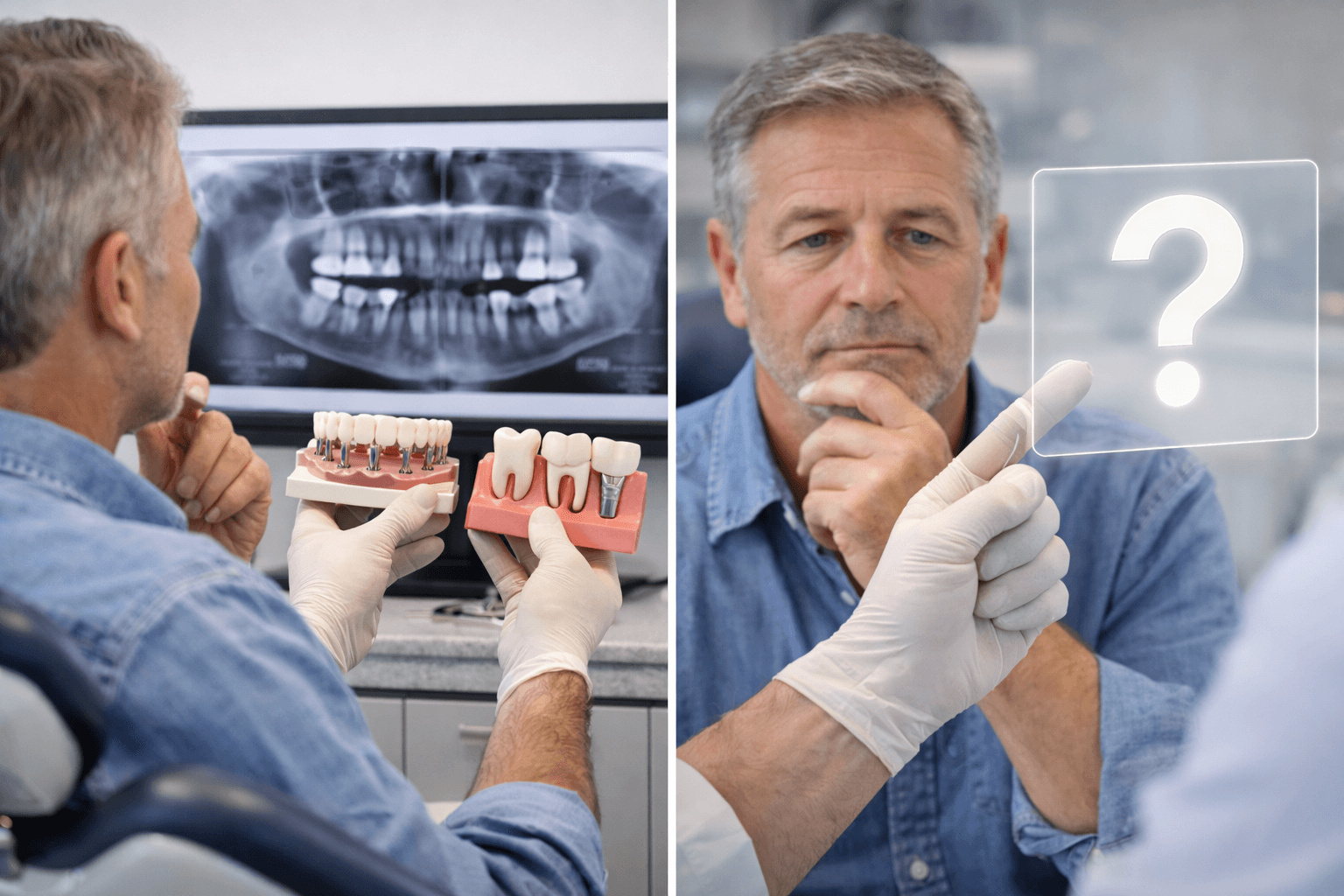
The Fundamental Difference: Two Philosophies of Dental Care
At the heart of this debate are two different philosophies about dental treatment:
The All-on-4 Philosophy: This approach views severely compromised teeth as liabilities. The reasoning is that if multiple teeth are failing or likely to fail in the coming years, it may be more predictable, cost-effective, and ultimately better for quality of life to remove all teeth and replace them with a fixed prosthesis supported by just four strategically placed implants per arch.
The Tooth Preservation Philosophy: This approach holds that natural teeth—even compromised ones—are worth saving whenever possible. Dentists following this philosophy believe that preserving your natural tooth structure, even if it requires multiple procedures, provides better long-term outcomes and maintains more of your natural oral anatomy.
Neither philosophy is inherently wrong. The question is: which one applies to your specific situation?
What Is All-on-4? Understanding Full Mouth Reconstruction
All-on-4 is a dental implant technique that replaces an entire arch of teeth (upper or lower) with a fixed prosthesis supported by just four dental implants. The name literally describes the approach: "all" teeth on "four" implants.
How All-on-4 Works
The procedure involves several key steps:
- Extraction of remaining teeth (if any are present)
- Strategic placement of four implants per arch, with the back implants angled to maximize bone contact and avoid anatomical structures like sinuses
- Immediate or near-immediate loading with a temporary fixed prosthesis
- Final prosthesis placement after healing (typically 3-6 months later)
The result is a full arch of fixed teeth that look, feel, and function similarly to natural teeth. Patients cannot remove the prosthesis themselves—it's permanently attached to the implants, though a dentist can remove it for maintenance.
When All-on-4 Is Typically Recommended
Dentists may legitimately recommend All-on-4 when:
- Most or all teeth are already missing or failing: If you have advanced periodontal disease affecting most teeth, extensive decay, or multiple failed root canals, the prognosis for keeping those teeth may be poor.
- Severe bone loss is present: All-on-4 uses angled implants and specific placement strategies that can work with less bone than traditional implant approaches, potentially avoiding bone grafting.
- Multiple teeth need extraction anyway: If you're facing the extraction of 8-12+ teeth regardless, All-on-4 might provide a more predictable outcome than trying to save a few compromised teeth.
- Patient wants a definitive, predictable solution: Some patients prefer the certainty of a complete reconstruction over the uncertainty of trying to save questionable teeth that might fail later.
- Complex dental history with multiple failures: If you've had numerous dental procedures that haven't held up, All-on-4 offers a fresh start with a proven success rate.
The All-on-4 Experience: What to Expect
Timeline: The entire process typically takes 3-6 months from initial surgery to final prosthesis, though you'll have temporary teeth immediately or within days of surgery.
Recovery: Expect 1-2 weeks of significant adjustment, with swelling, discomfort, and dietary restrictions. Most patients return to normal activities within a week but need several weeks to fully adapt to the new teeth.
Maintenance: You'll need regular professional cleanings (typically every 3-6 months) and meticulous home care with special tools to clean around the prosthesis. The prosthesis itself may need replacement every 10-15 years, though implants can last a lifetime.
Lifestyle impact: Most patients report dramatic improvements in confidence, eating ability, and quality of life. However, there's an adjustment period to the feel of the prosthesis, and some foods (very hard or sticky items) may remain challenging.
What Is Tooth Preservation? Understanding the Conservative Approach
Tooth preservation takes a more conservative, tooth-by-tooth approach. Rather than removing all teeth, this philosophy focuses on saving as many natural teeth as possible while replacing only those that are truly unsalvageable.
How Tooth Preservation Works
This approach might involve:
- Individual assessment of each tooth: Determining which teeth can be saved and which must be extracted
- Restorative procedures: Root canals, crowns, bridges, or other treatments to save compromised teeth
- Strategic implant placement: Replacing only the teeth that cannot be saved with individual implants or implant-supported bridges
- Periodontal treatment: Addressing gum disease to stabilize remaining teeth
- Ongoing maintenance: Regular monitoring and intervention to keep natural teeth healthy
The result is a mixed dentition—some natural teeth, some restorations, and some implants—customized to your specific dental situation.
When Tooth Preservation Is Typically Recommended
Dentists may legitimately recommend tooth preservation when:
- Many teeth are still healthy or salvageable: If you have 6-10+ teeth with good bone support and no active disease, preserving them may be the better long-term option.
- Younger patients with good oral hygiene: If you're under 50 and have demonstrated good dental care habits, your natural teeth may serve you well for decades with proper maintenance.
- Localized dental problems: If your issues are confined to specific areas (like back molars) rather than affecting your entire mouth, targeted treatment makes more sense.
- Strong bone and gum support: When the supporting structures are healthy, natural teeth have an excellent prognosis and are worth preserving.
- Patient preference for natural teeth: Some patients strongly prefer keeping their natural teeth and are willing to invest in the maintenance required.
- Medical or financial considerations: Tooth preservation can sometimes be staged over time, making it more financially manageable, and it typically involves less invasive surgery.
The Tooth Preservation Experience: What to Expect
Timeline: Treatment is often staged over months or even years, depending on the complexity. You might have multiple appointments for different procedures.
Recovery: Because treatment is typically less invasive and staged, recovery periods are shorter and more manageable—usually a few days after each procedure.
Maintenance: Natural teeth require consistent home care and regular dental visits (typically every 6 months). You'll need to stay vigilant about oral hygiene to prevent future problems.
Lifestyle impact: Most patients experience minimal lifestyle disruption, as they're keeping much of their natural dental structure. However, there may be ongoing concerns about the longevity of compromised teeth.
Side-by-Side Comparison: All-on-4 vs Tooth Preservation
Let's compare these approaches across the factors that matter most to patients:
Cost Comparison
All-on-4:
- Upfront cost: Higher initial investment, typically $15,000-$30,000 per arch (prices vary significantly by location and provider)
- Long-term costs: Prosthesis replacement every 10-15 years ($3,000-$8,000), regular maintenance cleanings
- Predictability: Costs are more predictable since you're addressing everything at once
- In Turkey: Often 50-70% less expensive than Western countries, typically $5,000-$12,000 per arch at quality clinics
Tooth Preservation:
- Upfront cost: Lower initial investment, but varies widely depending on how many teeth need treatment
- Long-term costs: Ongoing potential for additional procedures as teeth age; individual implants ($1,500-$3,000 each), crowns ($500-$1,500 each), potential root canals, etc.
- Predictability: Less predictable—you might need additional work in 5-10 years
- In Turkey: Also significantly less expensive than Western countries, with individual implants around $500-$1,200 and crowns $150-$400
Cost Reality: All-on-4 often appears more expensive initially but may be more cost-effective over 15-20 years if you would otherwise need multiple procedures on natural teeth. However, if your natural teeth remain healthy, preservation is almost always more economical.
Treatment Timeline
All-on-4:
- Surgery day: 2-4 hours per arch
- Temporary teeth: Immediate or within 1-3 days
- Final prosthesis: 3-6 months after surgery
- Total active treatment time: 3-6 months
- Advantage: Faster path to a complete, stable result
Tooth Preservation:
- Varies dramatically based on needed procedures
- May involve multiple appointments over 6-12+ months
- Some procedures can be staged over years if needed
- Advantage: More flexible timeline, can be adapted to your schedule and budget
Success Rates and Longevity
All-on-4:
- Implant success rate: 94-98% over 10 years (when performed by experienced surgeons)
- Prosthesis lifespan: 10-15 years before replacement needed
- Predictable outcomes with proper maintenance
- Complications: Implant failure (2-6%), prosthesis fracture, screw loosening
- Key factor: Success heavily depends on surgeon experience and proper patient selection
Tooth Preservation:
- Natural tooth retention: Highly variable (60-95% over 10 years depending on initial condition)
- Individual implant success: 95-98% over 10 years
- Crown/restoration lifespan: 10-15 years average
- Complications: Tooth loss requiring additional implants, root canal failures, crown replacements
- Key factor: Success depends on initial tooth condition, patient oral hygiene, and regular maintenance
Daily Life and Functionality
All-on-4:
- Eating: Can handle most foods after healing; very hard or sticky foods may be challenging
- Speaking: Brief adjustment period (1-2 weeks); most patients adapt completely
- Sensation: Different from natural teeth; some patients report reduced taste sensation or feeling
- Confidence: Most patients report dramatic improvement in confidence and social comfort
- Cleaning: Requires special tools (water flossers, interdental brushes) and technique; more time-intensive than natural teeth
- Feeling: Fixed and stable; doesn't move or shift like dentures
Tooth Preservation:
- Eating: Natural chewing sensation and force; no restrictions once healed
- Speaking: No adjustment needed; maintains natural speech patterns
- Sensation: Preserves natural feeling and proprioception (awareness of tooth position)
- Confidence: Maintains natural appearance; no concerns about prosthesis visibility
- Cleaning: Standard brushing and flossing, though may require extra attention to implant areas
- Feeling: Completely natural for preserved teeth; implants feel very similar to natural teeth
Maintenance Requirements
All-on-4:
- Professional cleanings every 3-6 months (essential, not optional)
- Daily cleaning with water flosser and special brushes (15-20 minutes)
- Annual check-ups with X-rays to monitor implant health
- Prosthesis removal and professional cleaning every 1-2 years
- Potential prosthesis replacement every 10-15 years
- Time commitment: Higher daily maintenance, but fewer unexpected issues
Tooth Preservation:
- Professional cleanings every 6 months (standard dental care)
- Daily brushing and flossing (10-15 minutes)
- Ongoing monitoring of natural teeth for new problems
- Potential for unexpected procedures (root canals, crown replacements)
- Individual implants require similar care to natural teeth
- Time commitment: Standard dental care, but potential for more frequent interventions
Psychological and Emotional Factors
All-on-4:
- Pros: Definitive solution, no more dental anxiety about failing teeth, dramatic transformation
- Cons: Grief over losing natural teeth, adjustment to prosthesis, feeling of "artificial" teeth
- Best for: Patients who want closure on dental problems and a fresh start
Tooth Preservation:
- Pros: Keeps natural teeth, maintains familiar oral environment, gradual change
- Cons: Ongoing uncertainty about tooth longevity, potential for multiple procedures, continued dental anxiety
- Best for: Patients who value natural teeth and are comfortable with ongoing maintenance
Why Do Different Clinics Recommend Different Approaches?
Understanding why you might receive conflicting recommendations is crucial for making an informed decision. Here are the legitimate—and not-so-legitimate—reasons:
Legitimate Medical Reasons for Different Recommendations
Clinical judgment varies: Dentistry involves both science and clinical judgment. Two experienced dentists might genuinely disagree about whether a tooth with 40% bone loss is worth saving. One might see it as salvageable with proper treatment; another might view it as a future problem waiting to happen.
Different risk tolerance: Conservative dentists prefer to save teeth whenever possible, accepting some uncertainty. Aggressive dentists prefer predictable outcomes, even if it means removing teeth that might have lasted several more years.
Specialization and expertise: A periodontist (gum specialist) might be more optimistic about saving teeth with gum disease. An oral surgeon might be more confident in implant solutions. A prosthodontist (restoration specialist) might focus on the final aesthetic outcome.
Patient factors: Your age, overall health, oral hygiene habits, financial situation, and personal preferences should influence the recommendation. A 35-year-old with excellent hygiene might get a different recommendation than a 65-year-old with a history of poor dental care—even with similar dental conditions.
Technology and training: Clinics with advanced technology (3D imaging, guided surgery) and extensive All-on-4 experience might recommend it more confidently. Clinics with strong restorative capabilities might lean toward preservation.
Financial Motivations (The Uncomfortable Truth)
While we want to believe all recommendations are purely medical, financial incentives do exist:
All-on-4 is more profitable: A full-arch All-on-4 case generates significantly more revenue than individual restorations. Some clinics may over-recommend it for this reason.
Volume-based practices: Clinics that focus on high-volume, standardized procedures may push All-on-4 because it's more efficient and predictable for their business model.
Commission structures: In some countries, dentists or treatment coordinators receive commissions based on treatment value, creating incentive to recommend more expensive options.
Marketing investments: Clinics that have invested heavily in All-on-4 marketing and training need to generate cases to justify those investments.
Insurance and payment plans: Some clinics partner with financing companies and may recommend treatments that fit specific payment plan structures.
How to Identify Trustworthy Recommendations
Red flags that suggest financial motivation:
- Immediate recommendation for All-on-4 without thorough examination
- Dismissing all your teeth as "hopeless" without detailed explanation
- Pressure to decide quickly or "limited time" offers
- Unwillingness to provide a detailed, tooth-by-tooth assessment
- No discussion of alternatives or staged treatment options
- Reluctance to provide records for a second opinion
Green flags that suggest genuine medical judgment:
- Comprehensive examination with X-rays and detailed assessment
- Tooth-by-tooth analysis with prognosis for each
- Discussion of multiple treatment options with pros and cons
- Willingness to provide records for second opinion
- No pressure to decide immediately
- Clear explanation of why they recommend their approach for YOUR specific situation
- Acknowledgment of uncertainty where it exists
Common Misconceptions About Both Approaches
All-on-4 Misconceptions
Myth: "All-on-4 is always better because it's newer technology."
Reality: All-on-4 is a specific technique developed in the 1990s. It's excellent for the right candidates but isn't superior to tooth preservation when natural teeth are healthy.
Myth: "You'll never have dental problems again with All-on-4."
Reality: While you won't get cavities, you can still develop implant-related issues like peri-implantitis (inflammation around implants), prosthesis fractures, or implant failure. Maintenance is essential.
Myth: "All-on-4 is the 'easy' option."
Reality: The surgery is significant, recovery takes weeks, and there's a substantial adjustment period. It's not necessarily easier than preserving teeth—just different.
Myth: "Four implants aren't enough to support all those teeth."
Reality: When properly placed by an experienced surgeon, four implants per arch provide excellent support. The technique has decades of research supporting its effectiveness.
Tooth Preservation Misconceptions
Myth: "Dentists only want to preserve teeth to make more money over time."
Reality: While ongoing care does generate revenue, many dentists genuinely believe in preserving natural teeth whenever possible based on research showing natural teeth provide better proprioception and bone preservation.
Myth: "If one dentist says your teeth can be saved, they definitely can be."
Reality: Prognosis involves uncertainty. A tooth might be "savable" but have only a 50% chance of lasting 5 years. Different dentists weigh these probabilities differently.
Myth: "Natural teeth always last longer than implants."
Reality: Healthy natural teeth with good bone support typically outlast implants. But compromised natural teeth may fail sooner than well-placed implants.
Myth: "Tooth preservation is always cheaper."
Reality: If preserved teeth require multiple root canals, crowns, and eventually fail anyway, the cumulative cost can exceed All-on-4. It depends on the specific situation.
Real-World Considerations: Beyond the Clinical Facts
Your Age and Life Stage
Younger patients (under 45): Tooth preservation often makes more sense because:
- Natural teeth could last 30-40+ years with proper care
- You have time to stage treatments financially
- Bone preservation around natural teeth benefits long-term oral health
- All-on-4 prostheses will need replacement multiple times over your lifetime
Middle-aged patients (45-65): The decision is more nuanced:
- Consider your overall health trajectory and ability to maintain teeth
- Evaluate whether you want to deal with potential dental issues in retirement
- Balance the predictability of All-on-4 against the benefits of natural teeth
- Consider your lifestyle and whether extensive dental maintenance fits
Older patients (65+): All-on-4 may be more appropriate because:
- A single comprehensive solution may be preferable to ongoing treatments
- Natural teeth that have lasted this long might not last another 20+ years
- The prosthesis may last the rest of your life without replacement
- Reduced ability to perform complex oral hygiene as you age
Your Oral Hygiene Habits and Commitment
Be honest with yourself:
- Do you floss daily and brush twice a day consistently?
- Do you attend regular dental check-ups?
- Have you successfully maintained dental work in the past?
- Are you willing to invest 15-20 minutes daily in oral care?
If yes: Tooth preservation may work well for you, as you have the discipline to maintain natural teeth and implants.
If no: All-on-4 might be more predictable, though it still requires diligent cleaning. However, if you struggle with oral hygiene, you should address this before any major dental work.
Your Financial Situation and Priorities
If you can afford comprehensive treatment now: All-on-4 provides a predictable, one-time investment (plus maintenance). You'll know your costs upfront.
If you need to stage treatment financially: Tooth preservation allows you to address urgent issues first and spread costs over time.
If you're on a fixed budget: Consider the long-term costs. Sometimes paying more upfront for All-on-4 is more economical than years of ongoing treatments on failing teeth.
If you're traveling for treatment: All-on-4 can often be completed in one trip (or two shorter trips), while tooth preservation might require multiple visits over time.
Your Lifestyle and Priorities
If you travel frequently or live remotely: All-on-4 requires less frequent dental visits once established (though maintenance is still essential).
If you're anxious about dental work: All-on-4 provides closure—one major procedure and you're done. Tooth preservation involves ongoing appointments.
If you value natural sensation and function: Preserved natural teeth provide superior proprioception and chewing force.
If you want predictability and finality: All-on-4 offers a definitive solution with known outcomes.
Factors That Should Influence Your Decision
Medical Factors
Bone quality and quantity: Severe bone loss may make tooth preservation difficult but could still allow All-on-4 (which requires less bone).
Periodontal disease status: Active, aggressive gum disease that hasn't responded to treatment suggests poor prognosis for natural teeth.
Number of failing teeth: If 12+ teeth are compromised, All-on-4 becomes more logical. If only 3-5 teeth are problematic, preservation makes more sense.
Tooth mobility: Teeth with significant mobility (movement) have poor prognosis and may not be worth saving.
Root canal history: Multiple failed root canals suggest teeth that are difficult to save long-term.
Systemic health: Conditions like uncontrolled diabetes, smoking, or immune disorders affect both natural teeth and implants but may make predictable All-on-4 outcomes preferable.
Personal Factors
Your goals: Do you want the "best possible" outcome or the "most predictable" outcome? These aren't always the same.
Your timeline: Do you need a solution quickly, or can you stage treatment over time?
Your risk tolerance: Are you comfortable with uncertainty about natural tooth longevity?
Your values: How important is keeping natural teeth to you emotionally?
Your support system: Do you have someone to help during recovery from major surgery?
Practical Factors
Geographic location: If you're traveling internationally for treatment, logistics favor procedures that can be completed in fewer trips.
Dentist expertise: The skill and experience of your dentist matters enormously. An excellent tooth preservation dentist might achieve better outcomes than an inexperienced All-on-4 surgeon, and vice versa.
Follow-up care: Consider where you'll receive ongoing care and maintenance after initial treatment.
Insurance coverage: Some insurance plans cover certain procedures but not others (though most don't cover implants).
How to Make the Right Decision for YOU
Step 1: Get a Comprehensive Evaluation
You need:
- Full mouth X-rays (panoramic and periapical)
- 3D CBCT scan if considering implants
- Comprehensive periodontal examination (gum and bone measurements)
- Tooth-by-tooth assessment with prognosis
- Discussion of your medical history and risk factors
Don't accept a treatment recommendation without this thorough evaluation.
Step 2: Understand Your Specific Situation
Ask your dentist:
- What is the prognosis for each tooth individually?
- Which teeth absolutely must be extracted?
- Which teeth are questionable but might be saved?
- Which teeth are healthy and should definitely be preserved?
- What are the success rates for saving questionable teeth in situations like mine?
- What happens if we try to save teeth and they fail in 3-5 years?
Step 3: Get a Second Opinion (or Third)
This is crucial. Different dentists will have different perspectives, and you need to understand the range of reasonable treatment options.
Important: Make sure your second opinion comes from a dentist with different expertise or philosophy than the first. If your first consultation was at an All-on-4-focused clinic, get your second opinion from a restorative dentist who specializes in tooth preservation, and vice versa.
Step 4: Consider Your Long-Term Vision
Think about:
- Where do you want to be in 10 years? 20 years?
- What does success look like to you?
- What are you willing to invest (time, money, effort) in dental care?
- What risks are you comfortable taking?
Step 5: Make an Informed Decision
There's rarely one "right" answer. The best choice is the one that:
- Addresses your clinical needs appropriately
- Aligns with your values and priorities
- Fits your financial situation
- Comes from a skilled, trustworthy provider
- Feels right to you after thorough research
The Role of International Treatment: Special Considerations
Many patients consider traveling to countries like Turkey for dental treatment due to significant cost savings. This adds another layer to your decision-making:
Advantages of International Treatment
Cost savings: Quality dental care in Turkey costs 50-70% less than in Western countries, making comprehensive treatment accessible.
Experienced providers: Popular dental tourism destinations have clinics that perform high volumes of complex cases, building substantial expertise.
Modern facilities: Many international clinics have state-of-the-art technology and facilities that rival or exceed those in Western countries.
Comprehensive packages: Treatment often includes accommodation, transfers, and coordination, simplifying the process.
Challenges of International Treatment
Due diligence is harder: Researching clinics, verifying credentials, and assessing quality from abroad is challenging.
Communication barriers: Language differences can complicate consultations and informed consent.
Follow-up care: You'll need a local dentist for ongoing maintenance and any complications.
Variable quality: The dental tourism industry includes both excellent clinics and problematic ones. Distinguishing between them requires expertise.
Legal recourse: If something goes wrong, pursuing accountability across international borders is difficult.
Making International Treatment Safer
Do extensive research: Don't choose based on price alone. Investigate credentials, experience, and patient reviews.
Verify independently: Look beyond clinic websites and marketing materials. Seek independent verification of claims.
Understand the full picture: Know what's included, what's not, and what happens if complications arise.
Plan for follow-up: Identify a local dentist willing to provide ongoing care before you travel.
Get professional guidance: Consider using a patient advocacy service that can provide unbiased assessment and protection.
How TürkiyeDental Can Help You Navigate This Decision
Making the choice between All-on-4 and tooth preservation is complex, and the stakes are high. You're not just choosing a treatment—you're choosing your quality of life for years to come.
This is exactly why TürkiyeDental exists.
We Provide the Clarity You Need
Second Opinion Service: If you've received a treatment plan—whether for All-on-4, tooth preservation, or anything else—our independent dental professionals will review it and provide an unbiased assessment. We'll tell you:
- Whether the recommended treatment is medically appropriate for your situation
- If there are alternative approaches you should consider
- Whether the pricing is fair and reasonable
- What questions you should ask before proceeding
Clinic Insight Report: If you're considering treatment in Turkey but don't know which clinic to trust, we provide deep-dive research into specific clinics:
- Professional reputation and credentials verification
- Analysis of past patient experiences
- Ethical compliance assessment
- Red flags or concerns you should know about
- Honest evaluation of whether the clinic is right for your needs
Personalized Treatment Portfolio: If you're starting from scratch and don't know where to begin, we'll create a comprehensive comparison:
- Multiple treatment plans from different trusted clinics
- Transparent price comparisons
- Pros and cons of each option for your specific situation
- Recommendations based on your priorities and circumstances
Why Our Guidance Matters
We're independent: We don't work for any clinic. Our only commitment is to your health and safety.
We're experienced: Our team includes practicing dentists, legal professionals, and industry experts who understand both the clinical and business sides of dental tourism.
We're transparent: We tell you what you need to know, not what clinics want you to hear.
We're protective: If you've been misled, overcharged, or improperly treated, we provide legal guidance and mediation to protect your rights.
The Peace of Mind You Deserve
Choosing between All-on-4 and tooth preservation shouldn't feel like a gamble. With proper guidance, you can make this decision confidently, knowing you have:
- Accurate, unbiased information about your options
- Verification that your treatment plan is medically sound
- Assurance that you're working with a reputable provider
- Support if anything goes wrong
Your smile deserves safety, transparency, and expertise. We make sure you receive exactly that.
Conclusion: Your Path Forward
The question of whether to pursue All-on-4 or tooth preservation doesn't have a universal answer. Both approaches are legitimate, evidence-based treatments that can provide excellent outcomes—for the right patient, in the right circumstances, performed by the right provider.
All-on-4 is often the better choice when:
- Most of your teeth are failing or already missing
- You want a predictable, comprehensive solution
- You're willing to invest in a major procedure for long-term stability
- Your natural teeth have a poor prognosis despite treatment
- You value finality and closure on dental problems
Tooth preservation is often the better choice when:
- Many of your teeth are healthy or salvageable
- You value natural tooth sensation and function
- You're willing to commit to ongoing maintenance
- You prefer a conservative, staged approach
- Your teeth have a good prognosis with proper treatment
The most important factors in your decision are:
- The actual condition of your teeth and supporting structures
- Your personal values, priorities, and lifestyle
- Your financial situation and timeline
- The expertise and trustworthiness of your provider
- Your commitment to long-term maintenance
Don't let anyone pressure you into a decision before you're ready. This is your mouth, your health, and your investment. Take the time to:
- Get comprehensive evaluations
- Seek multiple professional opinions
- Research your options thoroughly
- Verify the credentials and reputation of any provider
- Ask every question until you feel confident
And remember: you don't have to navigate this alone.
Ready to Make an Informed Decision?
If you're feeling overwhelmed by conflicting recommendations or unsure which path is right for you, TürkiyeDental is here to help.
Get Your Second Opinion: Already have a treatment plan? Send it to us for an independent, unbiased review by experienced dental professionals. We'll tell you if it's medically sound, fairly priced, and right for your situation.
Research Your Clinic: Considering a specific clinic but want to verify their reputation? Our Clinic Insight Report provides the deep-dive investigation you need to make a safe choice.
Compare Your Options: Starting from scratch? We'll create a personalized treatment portfolio with multiple options from trusted providers, complete with transparent pricing and honest recommendations.
Protect Your Rights: Already received treatment and concerned about the outcome? Our legal guidance and mediation services help you understand your rights and pursue accountability.
Your dental health is too important to leave to chance. Let us help you make the right decision with confidence, clarity, and complete peace of mind.
Because your smile deserves nothing less than safety, transparency, and expertise—and that's exactly what we provide.
TürkiyeDental: Independent Patient Advocacy for International Dental Care
Protecting patients. Strengthening standards. Ensuring transparency.