Introduction
When you start asking for dental opinions and suddenly find yourself staring at 10, 20, even 30 different treatment plans, something breaks inside your confidence. One clinic tells you everything is fine. Another warns of severe bone loss. A third says implants might fail unless teeth are pulled immediately.
Prices swing wildly, the language becomes more alarming, and instead of feeling informed, you feel anxious, suspicious, and afraid of making a mistake you cannot undo. If you are considering dental treatment in Turkey and feel caught between clinics, conflicting advice, and high-stakes decisions, this guide exists for one reason: to help you slow things down, separate medical facts from sales pressure, and regain clarity before committing to a decision that affects your health, your finances, and your peace of mind.
Are You Feeling Overwhelmed by Conflicting Dental Opinions?
If you feel mentally exhausted, confused, or even mistrustful after hearing completely different diagnoses from different clinics, that reaction is normal. When one dentist talks about significant bone loss, another mentions possible infection, and a third reassures you that everything is manageable, your brain is forced into constant comparison mode.
This kind of overload does not mean your case is unusually complicated. It usually means you are being exposed to opinions given without full context, consistent standards, or the same diagnostic information. Feeling overwhelmed is not a weakness or indecision. It is a natural response when too many high-stakes judgments are presented without a clear, neutral frame to interpret them.
You can ground the conversation with basics like realistic timelines and warranty expectations.
Why Do So Many Clinics Give Completely Different Treatment Plans?
Dental treatment planning is not as standardized as many patients expect, and not every clinic evaluates you from the same starting point. Some clinics base their recommendations on limited photos, others on assumptions drawn from past cases, and some lean toward more aggressive plans to eliminate long-term risk or simplify treatment.
Add differences in clinical philosophy, risk tolerance, equipment, and even business models, and it becomes clear why one clinic may suggest a conservative approach while another jumps straight to full-arch solutions. When these plans are presented without explaining why they differ, it can feel like dentistry is arbitrary or unreliable. In reality, the missing piece is context, not competence.
If Everyone Uses "The Same Materials," Why Are Prices So Different?
"The same materials" rarely mean the same treatment reality. While implants, crowns, or prosthetics may carry similar brand names on paper, pricing is shaped by many invisible factors: the experience of the surgical team, the time allocated to your case, the number of specialists involved, diagnostic depth, contingency planning, laboratory quality, and how much risk the clinic is willing to carry.
Some clinics price aggressively low by standardizing cases and minimizing variables; others price higher because they plan for complexity, complications, and long-term follow-up from the start. When clinics do not explain what is included versus what is assumed, price differences feel arbitrary or even dishonest. The real issue is that you are comparing numbers without seeing the full scope behind them.
Are Clinics Exaggerating Bone Loss or Infection to Justify Higher Costs?
Not necessarily, but context matters more than the words themselves. Terms like bone loss and infection are real clinical conditions, yet they exist on a spectrum, not as yes-or-no diagnoses. One clinic may flag moderate bone reduction as a risk worth addressing early, while another may view the same finding as manageable without drastic intervention.
Problems arise when these warnings are delivered without explaining severity, certainty, or alternatives. Without proper context, patients can feel frightened into believing their situation is urgent or extreme, when it may simply require careful planning and confirmation with proper imaging.
How Serious Is Bone Loss Really - and When Is It Actually a Problem?
Bone loss is common, especially in areas where teeth have been missing for a long time, and on its own it does not automatically mean your treatment options are limited. The real question is not whether bone loss exists, but how much, where, and how stable the remaining bone is.
Mild to moderate bone loss can often be managed with standard implants, angled placement, or supportive techniques, while more advanced loss may require grafting or full-arch solutions, but only after proper imaging confirms the extent. Without a 3D CBCT scan and a clinical examination, bone loss is a possibility, not a conclusion.
Do You Really Need All-on-4 or All-on-6, or Are There Other Options?
All-on-4 and All-on-6 are effective solutions for certain cases, but they are not default treatments and they are rarely the only option. These full-arch procedures are typically considered when many teeth are missing, remaining teeth are not salvageable, or bone conditions make individual implants impractical.
In many situations, a combination of targeted extractions, single implants, bridges, or staged treatment can achieve stable, long-term results with less intervention. Full-arch solutions are often discussed early because they simplify planning and reduce variables, not because they are always medically necessary.
Compare approaches with the All-on-4 overview and All-on-6 guide.
Why Are Some Clinics Warning About Implant Failure Before You Even Arrive?
Clinics often try to manage risk before they fully understand your case, and they do this by speaking in possibilities rather than probabilities. When a clinic has not seen you in person or reviewed a full 3D CBCT scan, they may highlight worst-case scenarios like implant failure to protect themselves medically and legally.
Implant success depends on variables that cannot be confirmed remotely: bone density, bone quality, gum health, bite forces, and how your body responds during surgery. Warning about failure too early does not mean failure is likely. It means the clinic lacks enough verified information to speak with confidence.
Is It Normal to Feel Afraid of Traveling for Dental Treatment Abroad?
Yes, and that fear is far more rational than most people admit. Traveling abroad for dental treatment combines medical uncertainty with financial commitment, distance from home, and the fear of being stuck with a decision you cannot easily reverse.
Your mind is not resisting treatment; it is trying to protect you from loss, regret, and feeling powerless in an unfamiliar system. The key is not to eliminate fear by rushing forward, but to reduce it by gaining clarity, transparency, and realistic expectations before you travel.
If travel logistics are part of your decision, the travel planning guide breaks down timelines, recovery days, and clinic coordination.
How Can You Tell the Difference Between Medical Caution and Sales Pressure?
The difference lies less in what is being recommended and more in how and why it is explained. Medical caution is transparent: it outlines risks, explains uncertainty, and presents alternatives without urgency or emotional pressure. It leaves room for confirmation, second opinions, and patient choice.
Sales pressure often relies on absolute language (this will fail, this is your only option), rushed timelines, and recommendations that escalate quickly without fully verified diagnostics. A trustworthy approach gives you space to think, asks for the right information, and focuses on protecting outcomes, not closing decisions.
What Information Do Clinics Actually Need to Make an Honest Assessment?
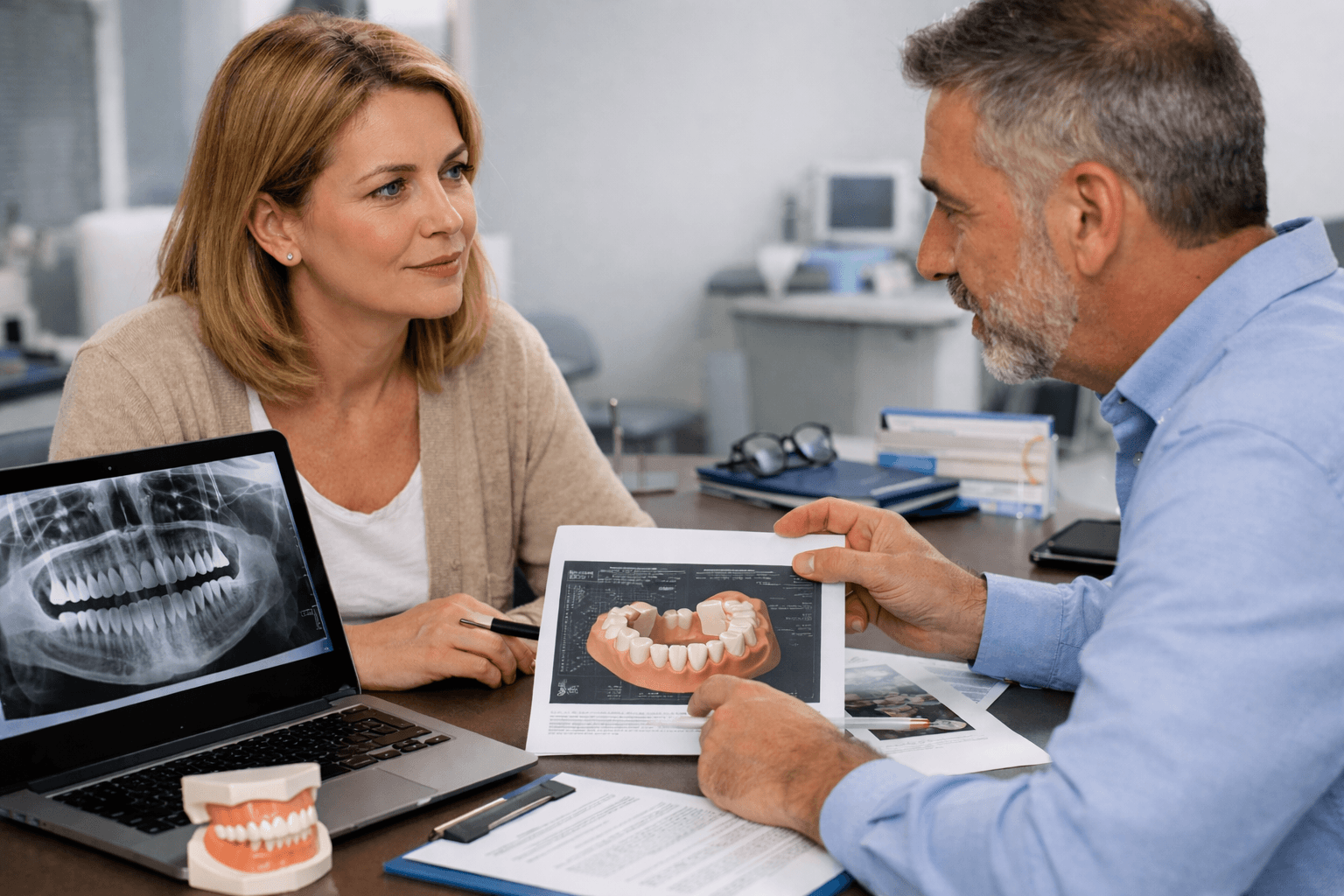
To make an honest and reliable assessment, clinics need objective diagnostic information, not assumptions. At a minimum, this includes clear intraoral photos, recent panoramic X-rays, and most importantly for implant planning, a 3D CBCT scan that shows bone volume, density, and anatomical landmarks.
They also need medical history, information about missing teeth timelines, gum health, and bite or grinding habits. Without these, any treatment plan is provisional at best. When clinics issue definitive recommendations without requesting or reviewing this data, they are not seeing your case. They are projecting a generalized scenario.
You can reference the timeline guide to match diagnostics with realistic treatment phases.
Why Getting Teeth Pulled Before Travel Is Often Misunderstood Advice
Being advised to have teeth pulled before traveling is often meant as a risk-management suggestion, not a strict requirement. In some cases, clinics worry that active infection or severe mobility could complicate implant surgery if left untreated, so they mention pre-extraction as a precaution.
Extractions are highly situational and depend on factors that cannot be fully assessed remotely, such as actual infection severity, bone condition after removal, and healing response. Many extractions are best evaluated and performed after proper imaging and clinical examination on arrival, making early removal a discussion point, not an obligation.
What Does a True "Second Opinion" Look Like in Dentistry?
A true second opinion is not just a different treatment plan. It is a different way of thinking about your case. Its purpose is not to replace one recommendation with another, but to bring clarity to why recommendations differ in the first place. When done properly, a second opinion reduces fear, restores trust, and gives you back control over the decision.
It Starts With Verification, Not Assumptions
A genuine second opinion begins by reviewing objective data, not by repeating conclusions. This includes examining existing X-rays, CBCT scans, clinical notes, and photographs to confirm what is visible versus what has been inferred. Statements like possible bone loss or suspected infection are clearly labeled as possibilities until verified.
It Separates Certainty From Probability
A trustworthy evaluation distinguishes between what will happen, what might happen, and what is simply a theoretical risk. Instead of using absolute warnings, it explains likelihoods, contributing factors, and how those risks can be managed or reduced.
It Explains Why Multiple Options Can Be Valid
More than one treatment path can often lead to a successful outcome. A true second opinion outlines conservative, moderate, and comprehensive options side by side and explains the trade-offs of each.
It Has No Urgency or Outcome to Sell
There is no countdown, no insistence on immediate commitment, and no emotional leverage tied to fear of failure. You are given space to process information, ask questions, and decide at your own pace.
It Leaves the Decision With You
A true second opinion empowers rather than directs. By the end, you should feel clearer about your condition, more confident in distinguishing facts from assumptions, and capable of making an informed choice.
How Can an Independent Dental Guide Protect You From Wrong Decisions?
An independent dental guide exists to remove pressure, not replace one clinic with another. Its role is to stand between you and conflicting opinions, translate complex dental language into clear terms, and help you understand what is confirmed, what is uncertain, and what requires further evaluation before any irreversible decision is made.
It Filters Information Before It Reaches You
Instead of being exposed to dozens of treatment plans all at once, an independent guide organizes and compares them using the same criteria. This reduces emotional overload and highlights where recommendations genuinely differ.
It Separates Medical Reality From Sales Dynamics
Because an independent guide does not perform treatment, it has no incentive to upsell, rush, or exaggerate. This neutrality helps identify when recommendations are based on confirmed diagnostics versus convenience or business structure.
It Slows Down High-Stakes Decisions
Wrong decisions often happen under time pressure and fear. An independent guide slows the process so diagnostics are completed, language is clarified, and alternatives are understood.
It Helps You Ask the Right Questions
Many patients do not know what to ask. A dental guide helps you formulate precise questions about assumptions, evidence, and what could change after in-person evaluation.
It Protects Your Confidence, Not Just Your Teeth
Beyond technical guidance, an independent guide restores a sense of control. Protecting you from the wrong decision is about ensuring that whatever decision you make is informed and aligned with your real needs.
Turkiye Dental Guide reduces risk by changing the decision process, not by steering you toward a specific treatment or clinic. Its value lies in neutrality, structure, and timing, helping you make sense of your situation before pressure, travel, or irreversible steps come into play.
How Does Turkiye Dental Guide Reduce Risk Without Pushing Treatment?
It Does Not Diagnose or Sell Treatment
Unlike clinics, Turkiye Dental Guide does not perform procedures, quote prices, or benefit from any treatment choice you make. This separation allows your case to be reviewed without the pull toward higher-value procedures or rushed timelines.
It Identifies What Is Confirmed vs. What Is Assumed
Risk often comes from acting on assumptions. The guide distinguishes between findings supported by diagnostics and those that are provisional, preventing early escalation into aggressive treatments.
It Encourages Verification Before Commitment
Rather than pushing remote commitments, the guide emphasizes confirmation: proper imaging, in-person evaluation, and staged decision-making.
It Reframes Options Without Urgency
Instead of presenting treatment as now or never, Turkiye Dental Guide explains how different paths can exist and what conditions justify each.
It Protects You From Regret, Not Just Complications
Medical risk is only one part of the equation. Financial strain, emotional stress, and post-treatment regret are equally real outcomes of rushed decisions. Slowing the process restores perspective.
In short, risk is reduced not by directing you toward treatment, but by ensuring that when you choose, you do so with clarity, context, and confidence.
What Happens When You Arrive in Turkey With the Right Expectations?
Arriving in Turkey with the right expectations changes the entire experience, medically, emotionally, and practically. Instead of bracing for surprises, you arrive prepared and grounded, which allows treatment decisions to unfold logically rather than reactively.
You Understand What Is Confirmed - and What Still Needs Evaluation
Final treatment plans are made after in-person examination and proper imaging, not before. You are not shocked if a recommendation is adjusted, because you already understand which parts were provisional.
You Are Not Alarmed by Medical Language
Terms like bone loss, infection, or surgical risk no longer trigger panic. You understand their context and relevance to your case.
You Can Evaluate Recommendations Rationally
Because you have been guided through possible scenarios, you can assess whether a proposed treatment aligns with what was discussed beforehand.
You Maintain a Sense of Control
You know what questions to ask, what information matters, and when it is appropriate to pause or seek clarification.
You Reduce the Risk of Regret
Most regret in dental tourism comes from feeling unprepared or misled. When expectations are realistic, outcomes feel aligned with the process, even if adjustments are needed.
Want more on the experience in specific cities? See destination notes for Istanbul, Antalya, and Izmir.
Can You Move Forward With Confidence Instead of Fear?
Yes, but confidence does not come from ignoring risk or forcing yourself to be brave. It comes from understanding what is known, what is uncertain, and what can be verified before irreversible decisions are made.
Moving forward with confidence means giving yourself permission to slow down, ask better questions, and seek guidance that is not tied to selling you a procedure. When you approach your decision this way, trust stops feeling risky because you know why you are choosing the path you are on.
From Confusion to Clarity: Making a Confident Dental Decision Without Fear
Navigating dental treatment decisions, especially across borders, can quickly become overwhelming when opinions conflict, risks are emphasized without context, and prices vary widely. This uncertainty often leads to fear, distrust, and hesitation, not because patients are indecisive, but because they are trying to protect themselves from making the wrong choice.
The key to moving forward is not rushing into treatment, but restoring clarity by understanding what is confirmed, what is assumed, and what still needs proper evaluation.
Turkiye Dental Guide exists to bring structure and calm to this process. By remaining independent, focusing on education rather than treatment, and helping patients interpret dental information without pressure, it reduces both medical and emotional risk. With the right expectations, verified diagnostics, and space to decide without fear, patients can move forward confidently.
Related reading: Free hotel dental scam guide and sleep and oral health insights.